
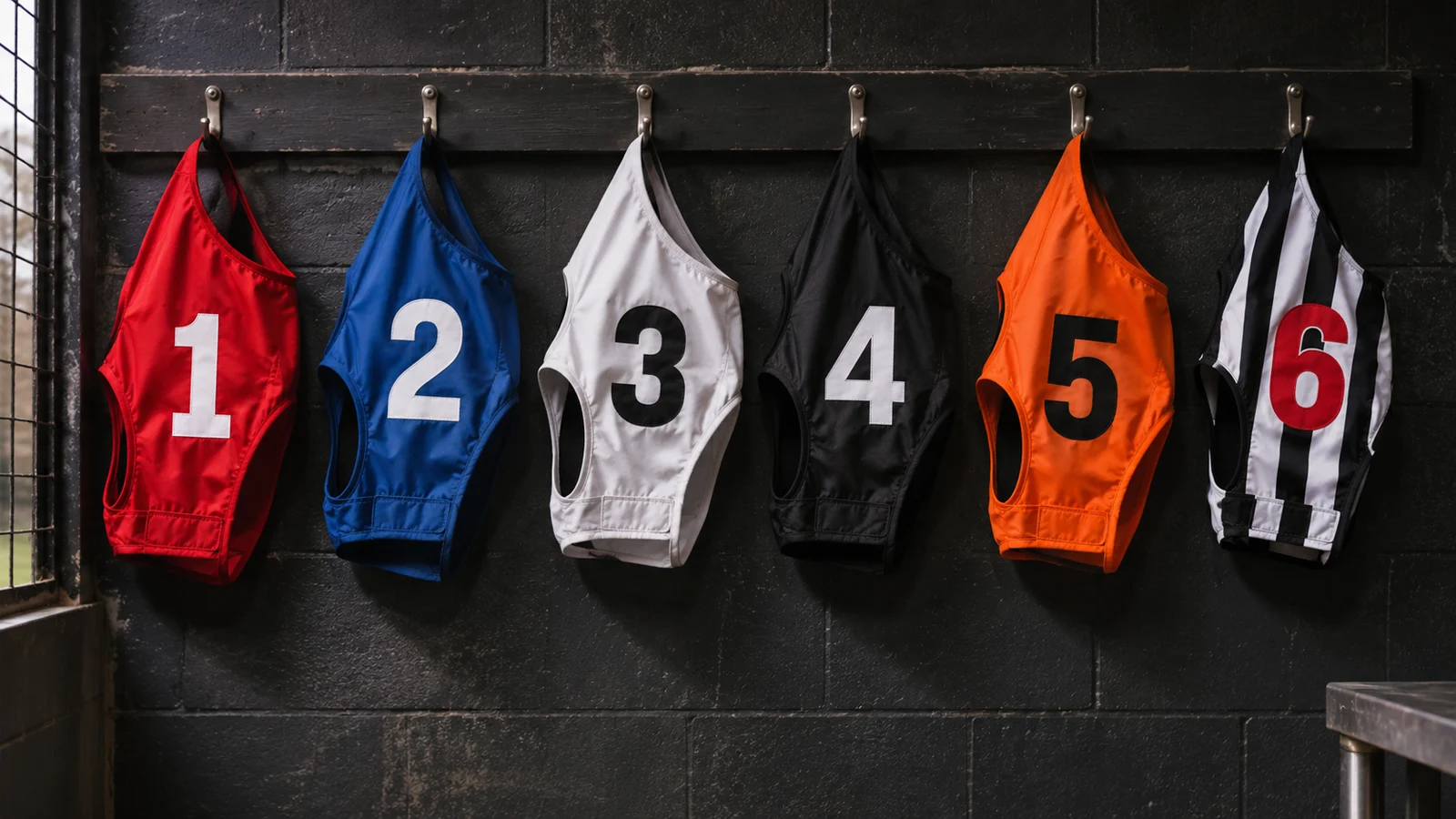
Greyhound racing gives every trap a colour because a number is hard to follow at full speed. The colour tells you which runner you are watching. The position of the trap tells you where it starts. Neither tells you, on its own, whether the draw is good.
That final judgement depends on the greyhound beside the colour.
The British greyhound trap colours
The current GBGB rules set out the standard jacket sequence:
| Trap | Jacket colour | Numeral |
|---|---|---|
| 1 | Red | White |
| 2 | Blue | White |
| 3 | White | Black |
| 4 | Black | White |
| 5 | Orange | Black |
| 6 | White and black stripes | Red |
Trap one starts nearest the inside rail. The numbers then run outwards across the track. On a normal six-runner card, trap six is the outside box.
The colour belongs to the trap, not to a permanent team or greyhound. The same dog can wear red from trap one at one meeting and black from trap four at another.
What do R, M and W mean?
These letters describe seeding, which is the racing manager's assessment of the starting line that best suits a greyhound.
W marks a seeded wide runner. Under Rule 78, it is considered best suited to starting outside runners that are not classified wide.
M marks a middle runner. It is considered best suited to starting inside wide runners and outside railers.
A railer is best suited to starting inside middle or wide runners. On many cards the railer is left without an R beside its name because rail is the unseeded classification. Some form displays may make the designation more explicit, so check the key used by the provider.
Seeding is not a claim that the greyhound will run along one painted line from start to finish. It is an administrative classification used to arrange the draw more safely and sensibly.
How the draw is organised
In graded racing, trap positions are allocated with the seeded runners ordered around the unseeded railers. In open racing, the declared seeding affects the draw procedure under the published rules and race conditions.
The objective is not to hand one greyhound an advantage. It is to reduce obvious conflict between incompatible running lines. A wide runner placed inside a group of railers would have to move across them to reach its preferred route. The seeding rules are intended to avoid that sort of arrangement.
There can still be conflict. Two railers may both move sharply towards the fence. A middle seed may edge inward before settling. A runner can change its behaviour after the break because another greyhound occupies the intended space.
The draw is a starting map, not a promise of clear passage.
Is trap one always best?
No.
Trap one is the shortest route around the inside only if the runner uses that ground efficiently and gets there without losing momentum. A greyhound that breaks slowly or moves away from the rail may surrender any theoretical advantage. A true railer can appreciate trap one; a runner seeking middle ground may not.
The same applies outside. Trap six can give a wide seed room to accelerate, but it can also mean covering more ground around the bends. Whether that matters depends on the dog, the track and the runners inside.
Long-term trap statistics describe what happened to groups of races. They do not automatically explain today's field. A trap can appear successful because of the types of runners drawn there, the distances used or a limited sample. Use statistics to ask a question, not to close the case.
How to read the run to the first bend
Imagine the six greyhounds not as fixed lanes but as moving intentions.
The railers want inside ground. The middle runners want space beyond them. The wide seeds are likely to hold or seek an outer route. Add their early pace and a possible shape begins to emerge.
If trap two is a fast-starting railer and trap one regularly breaks slowly, trap two may try to cross towards the fence. If traps three and four both edge inward, the available space can tighten quickly. A wide seed in six may have a clean outside run, but only if it begins well enough to use it.
This is why the sectional and the seed belong together. Early speed determines which runner reaches the contested ground first.
When is a draw genuinely favourable?
A favourable draw usually provides a plausible clean route.
Look for a greyhound whose preferred line is not being challenged immediately. An early-paced railer with slower starters around it may be able to hold the inside. A wide seed can benefit when the runners inside move left rather than carrying it further out.
Then look for evidence that the dog can take advantage: repeated good breaks from similar traps, predictable movement towards its seeded line and proof that it can handle the first bend at this course.
One old win from the same colour is not enough. The neighbouring runners change, and so does the race.
Vacant traps and reserves
A withdrawal can leave a vacant trap. The visual gap may create more room, but its effect depends on where it appears. Empty space beside an early-paced runner can reduce immediate pressure; an outside vacancy may make little difference to a railer already focused on the fence.
Reserves can replace withdrawn runners under the rules. When that happens, check the revised card and trap position rather than relying on an earlier preview. A late change can alter the intended first-bend picture.
The mistakes that make colours misleading
The most common mistake is saying that one colour is lucky. Traps are positions, not charms.
Another is reading W as meaning a greyhound must lead on the outside. It means the runner is classified as best suited to an outer starting position. Pace and performance remain separate questions.
A third is ignoring the track. Bend radius, run-up and distance to the first turn change the value of early position. Evidence from one venue should not be transferred carelessly to another.
Finally, do not use the draw to excuse every defeat. Trouble can matter, but poor starts and lost positions can also be recurring parts of a greyhound's profile.
A simple trap-reading routine
Write R, M or W beside every runner, even if railers are unmarked on the card. Draw arrows for the likely movement from the traps. Then mark the two or three quickest starters using repeated, comparable sectionals.
Where do the arrows meet?
That is the part of the race worth studying on replays. It may show one runner facing pressure and another receiving space. It may also show that the field is more balanced than the first glance suggested.
Move next to our guide to sectional times, then use the full race-form method to test the picture against recent runs.
The jackets help you follow the action. Seeding helps you understand the intended order of the draw. The real analysis begins when colour, running line and early pace are read as one contest.
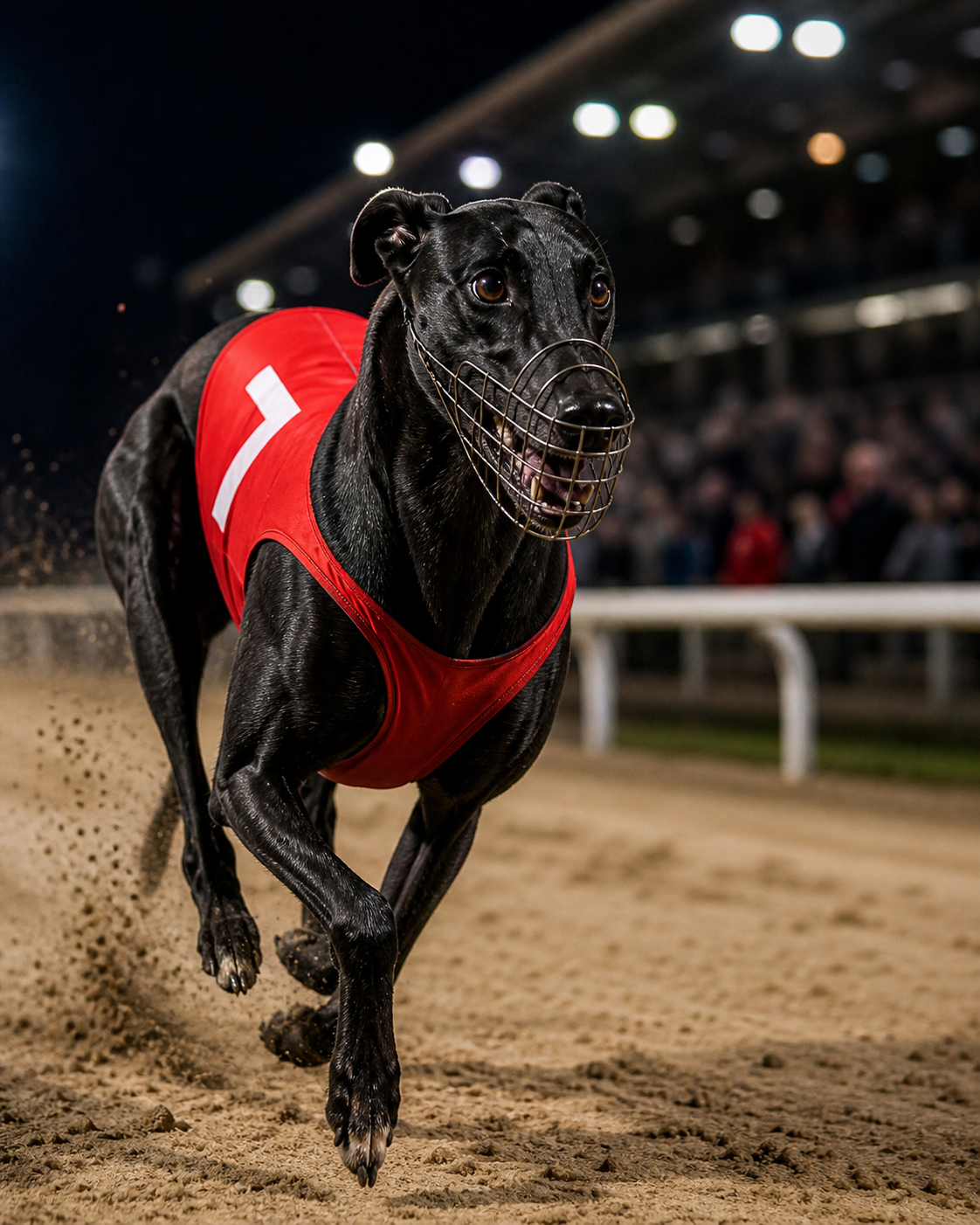 How greyhound racing works: a beginner's guide
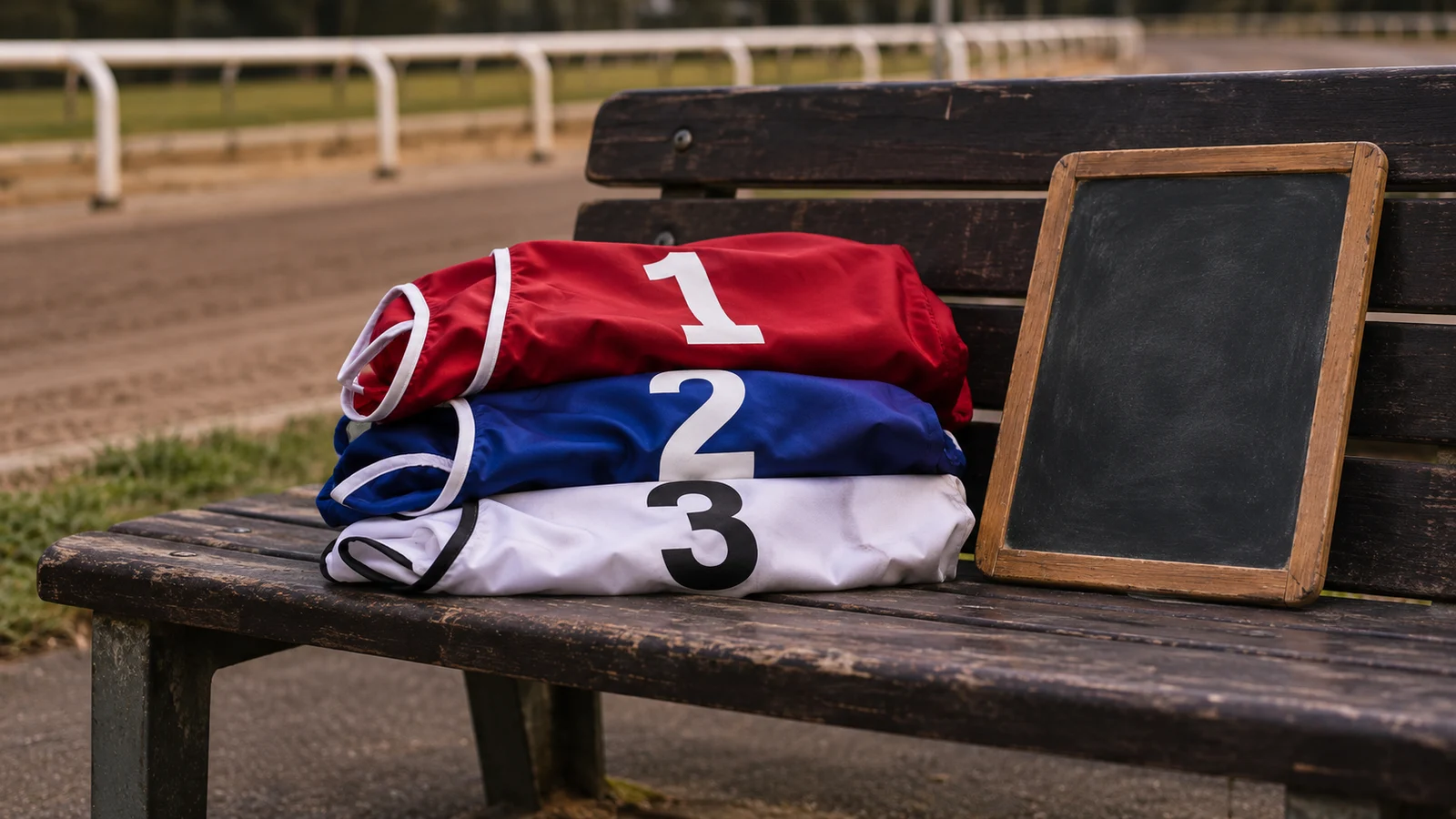 Greyhound racing grades explained
 Greyhound sectional times explained